Solana: an Operating System? (Ethereum + Bitcoin analogies)
Think of Solana as a distributed operating system running on thousands of validator “machines”.
Core OS Layer (non-negotiable system components)
BPF Loader → BIOS / Firmware
- Boots & loads executable programs
- Controls program upgrades
- Lives below user software
- Untouchable by apps
You install software with the BIOS — you don’t rewrite it.
System Program → Kernel (memory + process manager)
Handles:
- Memory allocation (account space)
- Ownership (permissions)
- Money movement (lamports)
OS analogy:
malloc()chmod()fork()bank_transfer()
If your program needs memory or money, it talks to the kernel.
Solana Runtime → OS Scheduler
- Executes instructions
- Enforces compute limits
- Runs programs in parallel
- Prevents crashes from spreading
Like Linux deciding which process runs when.
System Metadata Layer
Sysvars → Environment Variables / /proc
Examples:
- Clock → system time
- Rent → memory pricing rules
- EpochSchedule → epoch timing
Read-only system state exposed to apps.
Standard Libraries (shared across all apps)
SPL Token Program → libc / standard money library
- Token minting
- Transfers
- Balances
Like a standard financial library every app links against.
Associated Token Account Program → Filesystem conventions
- Deterministic paths
- One standard location per wallet + token
Think of it as /home/user/.config/ but for tokens.
SPL Memo Program → System logs / comments
- Attach human-readable notes
- No logic, just metadata
Token-2022 → Modern standard library (glibc v2)
- Transfer fees
- Interest
- Metadata extensions
Backward-compatible but more powerful.
Governance / Infra Services
Vote Program → Kernel voting / leader election
- Validators vote on blocks
- Maintains system integrity
Stake Program → Resource allocator
- Delegates voting power
- Controls system influence
Like CPU priority & scheduling weights.
User Space (where you build)
Your Program → User application
- Games
- DeFi
- NFTs
- AI agents
- Marketplaces
Rules:
- Can’t access memory directly
- Can’t move money directly
- Must syscall (CPI) into system programs
Exactly like user-space apps.
Full OS Mapping Table (with ETH + BTC analogies)
| Solana Component | OS Analogy | Ethereum Equivalent | Bitcoin Equivalent |
|---|---|---|---|
| BPF Loader | BIOS / Firmware | EVM bytecode loading + protocol rules (hard forks) | Script interpreter + consensus rules |
| System Program | Kernel (memory + process manager) | State transition function + system contracts/precompiles | UTXO validation + script semantics |
| Runtime | Scheduler | Client execution engine + block execution ordering | Miner/validator block assembly + execution |
| Sysvars | Env vars / /proc | Block header fields (timestamp, block number, base fee) | Block header fields (nTime, nBits, height) |
| SPL Token | Standard library | ERC‑20 standard tokens | Runes/Ordinals/Colored coins (protocol-level conventions) |
| Associated Token Account | Filesystem conventions | ERC‑20 balance mapping conventions | Standard script templates for token UTXOs |
| SPL Memo | Logs / comments | Event logs | OP_RETURN metadata |
| Token‑2022 | New stdlib | ERC‑20 + extensions (permit, fees, hooks) | Richer token metadata protocols |
| Vote Program | Leader election | PoS consensus votes/attestations | PoW miner selection |
| Stake Program | Resource allocation | Staking/validator set management | Hash power allocation + fee market |
| Your Program | User‑space app | Smart contract / dApp | Script / L2 app / covenant logic |
Visual mental model (Solana accounts)
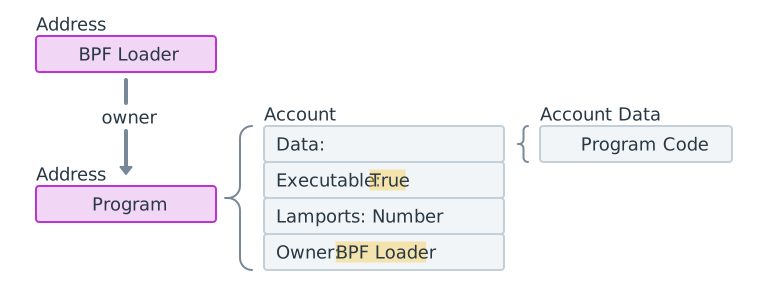
These diagrams make the “accounts store, programs execute” rule concrete.
Program account (expanded view)

Program account (simple view)
Data (state) account
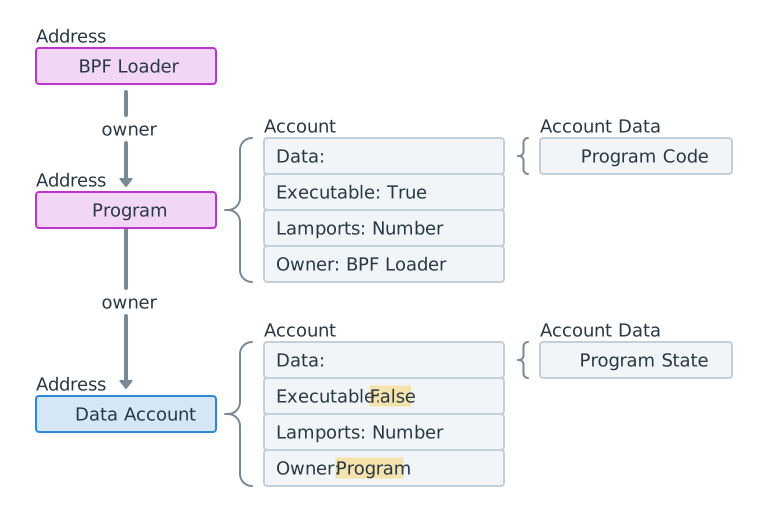
Solana Account Model (clean mental model)
Think of accounts as boxes on-chain, and programs as the only things allowed to open & change boxes.
System Account vs Program Account (Solana 101)
System Account
What it is:
- A data account owned by the System Program
- Can hold SOL
- May hold data (if allocated)
- Cannot execute code
Key idea: system accounts store state. They don’t run logic.
Examples:
- Your wallet address
- A PDA that stores app state
- A newly created account before ownership is reassigned
Program Account
What it is:
- An account that stores executable bytecode
- Marked executable = true
- Usually stateless
- Cannot hold mutable user data
Key idea: program accounts are logic-only. They don’t store app state.
Examples:
- System Program
- SPL Token Program
- Your deployed smart contract
Who Controls What? (Ownership)
| Account Type | Owner | Can Execute? | Holds SOL | Holds Data |
|---|---|---|---|---|
| System Account | System Program | ❌ | ✅ | ✅ |
| Program Account | BPF Loader | ✅ | ❌ | ❌ |
| PDA | Program | ❌ | ✅ | ✅ |
Known System Accounts
These are just accounts owned by the System Program:
- Wallet accounts: regular user wallets, hold SOL, sign transactions
- Program Derived Addresses (PDAs): deterministic, no private key, used for app state
Example PDAs:
user_profile_pdavault_pdaescrow_pda
Known Program Accounts (very important)
- System Program: creates accounts, transfers SOL, assigns ownership
- BPF Loader: loads & upgrades programs, owns executable program accounts
- SPL Token Program: mints tokens, transfers tokens, manages token accounts
- Associated Token Program: creates deterministic token accounts (wallet + mint → token account)
- Rent Sysvar: provides rent-exemption info
- Clock Sysvar: slot, epoch, Unix timestamp
The One-Line Rule (burn this in)
Programs execute. Accounts store.
Programs never store state. Accounts never run code.
Real-World Analogy
- Program account → backend service (code)
- System account / PDA → database row
- Transaction → API request
- Instruction → function call
Typical Flow (most Solana apps)
- Wallet signs transaction
- Instruction calls program
- Program reads/writes system accounts / PDAs
- SOL or tokens move
One-liner that locks it in
Solana is Linux. Programs are processes. CPIs are syscalls.
BPF Loader is the BIOS you never touch.